
Before Your Stay Abroad

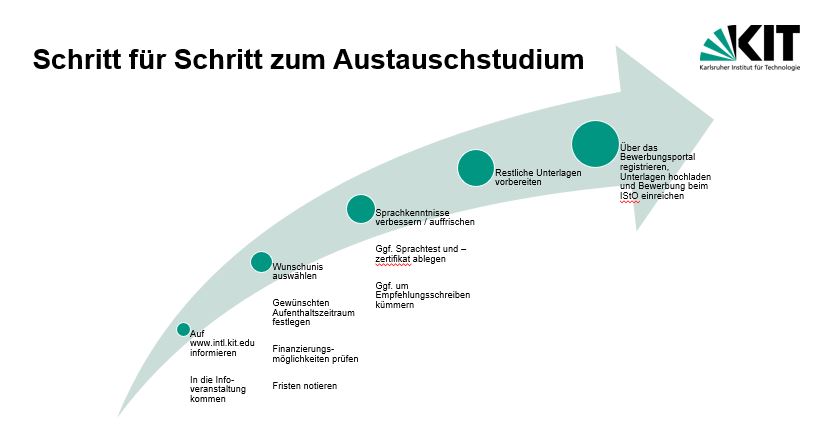
When planning a stay abroad, it’s important to do your research thoroughly in advance and start planning early, especially if you need to brush up on your language skills  or learn a new language before your stay abroad. Many scholarship and exchange programs have long application deadlines - one to one and a half years before the start of the planned stay is quite common. It is therefore advisable to allow sufficient time for preparations and to keep track of the application deadlines for the relevant programs well in advance.
For example, if you plan to go to China during your 5th bachelor’s semester through an IStO exchange program, you must have submitted your application by the end of your 2nd semester.
If you plan to study abroad during your master’s program, it may be best to apply before you begin your master’s studies.
When planning your stay, please note that the start of the semester in host countries is often significantly earlier than at KIT. To avoid conflicts with exam dates, plan well in advance and consult with your lecturers. We have provided an overview of the approximate semester dates here for you. If you want to find out the exact semester dates at a partner university, you can simply Google “academic calendar + NAME of the university.”
For initial information, we recommend that you first review the information on our website and then attend one of our Info Sessions. There, we’ll provide you with a general overview and take the time to answer your questions.
For any additional questions that may arise later, we offer email support and consultation hours. During consultation hours, you can ask questions that come up while you’re preparing your application materials - or simply listen in on others’ discussions.
At the Overseas Talks, you can meet students who have already returned from their exchange semester or year. Come to these events to get a sense of a destination country or university, learn from the experiences of former exchange program participants, or ask them questions yourself.
Be sure to check out our event calendar or subscribe to it to stay informed about upcoming courses.
The DAAD provides country-specific information on the country, its higher education and education systems, and research. The information ranges from details on types of higher education institutions and how degree programs are organized to visa requirements, finding housing, and the cost of living. In addition, the service section features numerous firsthand accounts, addresses of important organizations, and recommended links. How expensive is a city? At www.numbeo.com/cost-of-living, you’ll find data on the cost of living worldwide.
The IStO website features testimonials from former outbound students that can help you with your planning. KIT students have documented their personal impressions of the universities they visited and the course of their stays abroad. These reports should in no way be construed as an official assessment by KIT.
And if you simply want to get a taste of the wider world and find some inspiration? Then there are many more experience reports, photos, videos, and much more from students across Germany who share stories about their stays around the world at studieren-weltweit.de.
Thanks to cooperation within the Baden-Württemberg Programs and bilateral partnerships, regular tuition fees at the partner university are waived; however, students are still required to pay administrative and other fees (such as general administrative fees, meal plans, mandatory health insurance, etc.) charged by the respective partner university. Especially at U.S. and Canadian universities, students are often required to purchase health insurance locally. These and other costs—such as living expenses, travel, and insurance—are the responsibility of the students. Therefore, please be sure to review the relevant information provided by the partner universities (for example, search for “fees” or “costs for international students” or “exchange students”).
Information on funding and scholarship opportunities, as well as relevant scholarship databases, can be found here.
Be cautious when combining scholarships: Even a tuition-free exchange position is considered a scholarship. Any combinations must be coordinated with BOTH scholarship providers.
When looking for funding and scholarship options, you may want to look more closely at:
- German student financial aid for studies abroad (Auslands-BAföG) (The higher funding rates for studying abroad mean that many students are eligible for BAföG who would not receive funding in Germany because their parents’ income is too high. The application for funding for study abroad should be submitted at least half a year before departure.)
- Baden-Württemberg Scholarship
- PROMOS
- For stays in Israel: State Parliament Scholarship for Israel
Other combinations are possible depending on the scholarship provider and the purpose of the scholarship. Please feel free to contact cornelia stoll ∂does-not-exist.kit edu.
Under certain conditions, the costs of a semester or year abroad may be tax-deductible.
You can improve your language skills, for example, through the KIT Language Center’s language courses (in-person or Teletandem) or Studierendenwerk Karlsruhe | International | Tandem.
Buddy Program
Get paired with international first-semester students and gain firsthand insights into the opportunities and challenges that studying abroad can bring.
In preparation for your own stay abroad, expand your intercultural skills so you can calmly anticipate the culture shock that is sure to come.
Go all out and complete the full training program for local buddies, which can earn you not only ECTS credits but also buddy points that count toward a certificate of social engagement. You can find more information and the registration link here.
The House of Competence and FORUM offer seminars on the topic of intercultural competence, as well as those specifically designed to prepare you for stays abroad, such as:
- Überall zu Hause – Basic Training in Global Competence (Priority registration for participants in the INTL Buddy Program)
- I Will Survive! How to Deal with Culture Shock (Priority registration for those preparing for a stay abroad)
- Deconstructing Unconscious Bias into Intercultural Competence: A Neurological Look into How Our Brain Constructs Reality
- Intercultural Communications: USA and Germany
- Intercultural Competence – China and Germany
- China - woher kommst Du und wohin gehst Du?
- Wandlungsprozesse im arabischen Raum. Sozio- und geopolitische Dynamiken des Arabischen Frühlings und ihre internationale Resonanz
As a bonus, you can also earn a credit toward the Certificate in International Competence if everything works out.
Exchange students take a full-time course load. The specific requirements for this are defined by the host university.
Some of the accomplishments earned abroad may be transferred to KIT. Before you begin your stay abroad, find out about the credit transfer procedures for your degree program. The departmental coordinators serve as points of contact for incoming and outgoing students regarding academic matters such as the recognition of coursework and examinations earned abroad and learning agreements. In some cases, it may be advisable or even mandatory to coordinate the recognition of planned courses before your stay begins. Some departments provide credit transfer forms on their websites for this purpose.
Feel free to consult the reports of previous students on the topic of credit recognition.
It is not possible to earn an academic degree from the host university as part of this exchange program.
In addition, depending on the country you choose, there are numerous factors to consider. For example, you should determine whether a visa is required for the host country in question, as well as how far in advance and through which channels—and with which documents—you need to apply for that visa.
The website of the Federal Foreign Office can be helpful and provides general information about the current situation in the respective country as well as visa matters.
Detailed information on entry and visa requirements is provided by the relevant diplomatic missions (embassy, consulate general). You are also welcome to use the information linked on the websites of the respective partner universities.
Health Insurance
Before studying abroad, you should carefully check whether your existing health insurance covers you for the entire duration of your one- or two-semester stay abroad. If not, you should take out appropriate supplemental insurance either in Germany or in your destination country. Some universities, particularly in North America, also offer their own health insurance plans for students. Some of these health plans are optional, while other universities require students to enroll in the university’s health insurance plan.
Since statutory health insurance does not cover the flight or transportation costs incurred for repatriation to Germany in the event of illness or an accident, it is recommended that you purchase supplemental insurance for repatriation.
Please also check whether your health insurance covers treatment for COVID-19.
Liability Insurance
Before traveling abroad, you should verify whether your stay is covered by your existing liability insurance or through your host university and, if necessary, take out additional insurance.
You can find information on this topic on the Studierendenwerk Karlsruhe website. Please contact them for advice if you have any questions.
Accident Insurance
Before traveling abroad, you should check whether your stay is covered by your existing accident insurance or by the host university, and take out additional insurance if necessary.
If you’re going abroad through one of the overseas programs, accident insurance isn’t strictly necessary from a German perspective, but it’s highly recommended.
You can find information on this topic on the Karlsruhe Student Services website. Please contact them for advice if you have any questions.
A combined health, accident, and personal liability insurance policy
is offered by the DAAD through the group policy “” for students, graduates, postgraduates, and doctoral candidates who are funded or supervised through DAAD programs, as well as for interns. Students who are placed by KIT at a partner institution for a stay abroad can also obtain insurance through the DAAD. More information:
You may take a leave of absence from KIT for the duration of your stays abroad. However, the leave of absence should generally not exceed two semesters.
Semesters on leave count as semesters (at a German higher education institution) but are not included in the calculation of (subject-specific) semesters / terms. You may not attend KIT courses, complete accomplishments, or use various university facilities; however, you may take examinations at KIT (with the exception of theses or course-related examinations that require repeated use of resources). (As of Aug 2026)
The application for a leave of absence is submitted digitally to the Studierendenservice. To do so, download the confirmation from IStO in Mobility Online under the section “Before Your Stay – Nomination.”, and upload it in Campus Management for Studierendenwerk together with —as soon as it is available—the admission letter or enrollment certificate from the partner university.
Find out more about deadlines and procedures on the Studierendenservice page linked above.
For anyone who’s active on social media and enjoys writing: As a correspondent for “Study Abroad – EXPERIENCE IT!”, you can share your experiences abroad and inspire others to study abroad as well.
For more information, visit: studieren-weltweit.de/correspondent-bewerbung




For initial information or questions about the application: overseas∂intl kit edu
Office Hours and Informational Events